Introduction
Private label CPG manufacturing has reached unprecedented scale in 2025, with store brand sales hitting $282.8 billion and capturing 23.5% of all U.S. grocery units sold. This explosive growth reflects a fundamental shift: consumers no longer view private label as "generic" but as premium alternatives offering equal or better quality than national brands.
For entrepreneurs and established companies alike, private label manufacturing offers a strategic path to market without the capital burden of building production facilities. You maintain control over formulations, branding, and positioning while leveraging specialized manufacturers' expertise and economies of scale.
To help you navigate this landscape, this guide examines top private label CPG manufacturers across categories. We focus on critical selection criteria that determine fit:
- Minimum order quantities (MOQs) and pricing structures
- FDA compliance and facility certifications
- Turnaround times from order to shipment
- Specializations in formulations and product categories
Key Takeaways
- Private label CPG reached $282.8 billion in 2025, growing 3.3% versus 1.2% for national brands
- Manufacturers specialize by category (food, personal care, cosmetics, household, supplements)
- Key criteria include MOQs (ranging from 500 to 25,000+ units), certifications (FDA cGMP, USDA, NSF), and turnaround times
- Low-MOQ manufacturers (500-1,000 units) enable startups to test products without massive capital risk
- Regulatory compliance varies by category and impacts retail distribution opportunities
Overview of Private Label CPG Manufacturing in the U.S. Market
Private label CPG manufacturing refers to the production of consumer packaged goods sold under a retailer's or brand's name rather than the manufacturer's brand.
This model spans every major category: food and beverage, personal care, cosmetics, household cleaning products, and dietary supplements.
The market momentum is undeniable. Private label captured 21.2% of dollar sales and 23.2% of unit sales in the first half of 2025, with growth rates outpacing national brands by a 4:1 margin. Nearly all U.S. households now purchase private label products across grocery, health and beauty, and household categories.
This growth has created a diverse U.S. manufacturing landscape serving businesses at every stage:
- Stock formulations with MOQs as low as 50-100 units for concept testing
- Semi-custom formulations at 1,000-5,000 units for scaling brands
- Fully custom products with 10,000+ unit runs for established companies
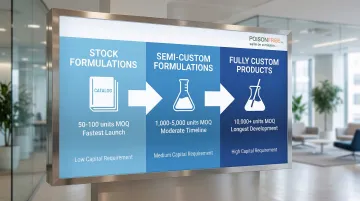
Services range from simple white-label products—where you select from a catalog and add your logo—to comprehensive contract manufacturing. The latter includes dedicated R&D, custom formulation development, and full regulatory support.
Top Private Label CPG Manufacturers
Finding the right private label manufacturer can make or break your product launch. The manufacturers below represent the top performers across major CPG categories, evaluated for production capabilities, certifications, MOQs, and track record with both startups and established brands.
Poison-Free Private Label
Based in Northern Texas, Poison-Free Private Label is a family-owned manufacturer founded 30 years ago with a distinctive philosophy: "if I won't use it, I won't make it."
The company specializes in toxin-free personal care and household products, offering over 100 formulations made exclusively from plants, minerals, and vitamins.
What sets them apart:
- Industry-leading low MOQ of 500 units versus the typical 10,000+ industry standard
- Transparent pricing with all orders priced as if you bought 10,000 units, regardless of quantity
- FDA cGMP compliant facility meeting Cosmetic Good Manufacturing Practices standards
- Fast turnaround with orders typically shipping within one week once materials arrive
Best fit for: Startups testing new product concepts, small businesses expanding existing brands, and any company prioritizing 100% toxin, poison, and petrochemical-free formulations.
| Criteria | Details |
|---|---|
| Minimum Order Quantity | 500 units (significantly lower than industry standard) |
| Specialization | Personal care and household products with 100% toxin-free formulations |
| Certifications & Compliance | FDA cGMP (Cosmetic Good Manufacturing Practices) compliant |
| Turnaround Time | Orders usually shipped within a week once materials are in house |
Private Label Nutraceuticals
Leading supplement manufacturers specialize in dietary supplements, vitamins, and nutraceuticals across multiple formats: tablets, capsules, powders, and gummies. These facilities serve both emerging supplement brands and established companies requiring consistent quality and regulatory compliance.
Top nutraceutical manufacturers offer:
- Comprehensive formulation support with in-house R&D labs
- NSF and GMP certifications ensuring third-party quality validation
- Stock formulations for faster launch and lower MOQs, plus custom blends for unique positioning
- Flexible MOQ tiers based on product complexity and format
Typical Production:
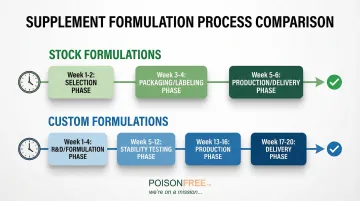
Stock formulations can launch in 4-6 weeks, while custom formulations requiring R&D and stability testing typically take 8-20 weeks from concept to delivery.
| Criteria | Details |
|---|---|
| Minimum Order Quantity | 5,000-10,000 units for custom formulations; as low as 50-100 units for stock formulas |
| Specialization | Dietary supplements, vitamins, nutraceuticals (tablets, capsules, powders, gummies) |
| Certifications & Compliance | NSF/ANSI 455-2, GMP certified, FDA registered facility, USP Verified |
| Turnaround Time | 4-6 weeks for stock products; 8-20 weeks for custom formulations |
Food & Beverage Private Label Manufacturers
Food and beverage manufacturers serve grocery retailers and emerging food brands with capabilities spanning shelf-stable foods, frozen products, and beverage production.
These facilities handle complex regulatory requirements and often require higher MOQs due to production run economics.
Leading food manufacturers provide:
- USDA and FDA compliance with FSMA (Food Safety Modernization Act) requirements
- Organic and non-GMO certification capabilities for clean-label positioning
- Co-packing services for brands owning their formulations
- Scalability from regional distribution to national rollout
Categories Served:
Beverages, packaged foods, frozen products, shelf-stable items, and specialty foods requiring specific certifications.
| Criteria | Details |
|---|---|
| Minimum Order Quantity | 10,000-50,000 units for beverages; 2,000-5,000 units for standard food items |
| Specialization | Shelf-stable foods, frozen products, beverages, co-packing services |
| Certifications & Compliance | USDA, FDA, FSMA compliance, SQF/BRCGS (GFSI schemes), USDA Organic, Non-GMO Project |
| Turnaround Time | 3-4 months for co-packing; 6-12 months for custom formulations with shelf-life testing |
Cosmetics & Beauty Private Label Manufacturers
Cosmetics-focused manufacturers specialize in color cosmetics, skincare, and beauty products, serving indie beauty brands and established cosmetics companies.
The MoCRA regulations implemented in 2022 have raised compliance standards, making manufacturer certification more critical than ever.
Beauty manufacturers stand out with:
- Trend-forward formulation capabilities tracking beauty industry innovations
- Clean beauty expertise with ingredient transparency
- Sustainable packaging options for eco-conscious brands
- Flexible MOQs supporting influencer and DTC beauty brands
MOQ Ranges:
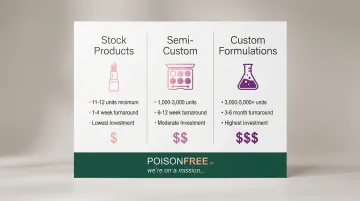
Stock products can start as low as 11-12 units, semi-custom formulations typically require 1,000-3,000 units, and full custom formulations start at 3,000-5,000+ units.
| Criteria | Details |
|---|---|
| Minimum Order Quantity | 11-12 units for stock; 1,000-3,000 for semi-custom; 3,000-5,000+ for custom formulations |
| Specialization | Color cosmetics, skincare, beauty products, clean beauty formulations |
| Certifications & Compliance | FDA MoCRA compliance (facility registration, product listing), Leaping Bunny, PETA cruelty-free, COSMOS/ECOCERT |
| Turnaround Time | 1-4 weeks for stock products; 3-6 months for custom formulations with compatibility testing |
Household Products Private Label Manufacturers
Household cleaning product manufacturers specialize in laundry care, surface cleaners, and home care items, serving both eco-conscious brands and traditional household product companies. Green chemistry capabilities and EPA certifications differentiate leaders in this category.
Household product manufacturers excel through:
- Green chemistry capabilities for plant-based formulations
- Biodegradable formulations meeting environmental standards
- EPA Safer Choice compliance for verified safer ingredients
- Production of both conventional and plant-based cleaning products
Production Standards:
MOQs are often determined by batch size, with typical minimums around 55 gallons (yielding 220-440 units depending on container size).
| Criteria | Details |
|---|---|
| Minimum Order Quantity | Typically 55-gallon batch minimum (220-440 units depending on container size) |
| Specialization | Household cleaning products, laundry care, home care, eco-friendly formulations |
| Certifications & Compliance | EPA Safer Choice, biodegradable certifications (OECD 301/310), Green Seal, green chemistry standards |
| Turnaround Time | 1-2 weeks for established formulas; 3-6 months for EPA Safer Choice certification |
How We Chose the Best Private Label CPG Manufacturers
Selecting the right manufacturer requires evaluating factors far beyond price. Three critical dimensions determine success:
1. Minimum Order Quantities (MOQs)
MOQs determine accessibility for startups and capital requirements for product launches. Lower MOQs (500-1,000 units) enable market testing with minimal risk but typically carry higher per-unit costs.
Higher MOQs (10,000+ units) offer better economics but require significant upfront investment and create inventory risk if the product underperforms.
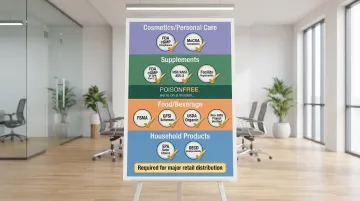
2. Certifications and Compliance
Regulatory requirements vary dramatically by category:
- Cosmetics/Personal Care: FDA cGMP and MoCRA compliance (facility registration, product listing, safety documentation)
- Supplements: FDA cGMP (21 CFR Part 111), NSF/ANSI 455-2, facility registration
- Food/Beverage: FSMA compliance, GFSI schemes (SQF/BRCGS), USDA Organic, Non-GMO Project
- Household Products: EPA Safer Choice, biodegradability standards (OECD 301/310)
Certifications directly impact retail distribution opportunities. Major retailers increasingly require third-party certifications as a condition of shelf placement.
3. Production Capabilities and Category Expertise
Manufacturers specialize by category and format. A supplement manufacturer may excel at tablets and capsules but lack gummy production capabilities. A food co-packer may handle beverages but not frozen products.
Verify the manufacturer's specific experience in your exact product category before committing.
What to Avoid When Selecting a Manufacturer
Understanding these evaluation criteria helps you avoid common pitfalls:
Common Mistakes Brands Make:
- Focusing solely on lowest price without evaluating quality consistency or regulatory compliance
- Overlooking certification requirements for target retail channels
- Underestimating lead times and failing to plan for inventory replenishment cycles
- Failing to verify manufacturer's experience in their specific product category and format
- Not requesting samples or visiting facilities before signing contracts
The Right Manufacturer Depends On:
- Your business stage (startup testing vs. established brand scaling)
- Order volume capabilities and capital availability
- Product category and format requirements
- Formulation needs (stock vs. semi-custom vs. fully custom)
- Values alignment (clean ingredients, sustainability, organic certification)
Conclusion
Choosing the right private label CPG manufacturer is a critical business decision that impacts product quality, time to market, startup costs, and long-term scalability. Factors like minimum order quantities, regulatory certifications, and category expertise vary dramatically across manufacturers, making thorough evaluation essential before starting production.
Before signing any agreement, take these verification steps:
- Request samples to evaluate product quality firsthand
- Verify certifications directly with issuing bodies
- Discuss formulation capabilities in detail with technical teams
- Ensure the manufacturer's values align with your brand positioning
- Visit facilities when possible to assess cleanliness and operational professionalism
If your evaluation prioritizes toxin-free formulations and lower entry barriers, Poison-Free Private Label provides 30 years of manufacturing experience, FDA cGMP compliance, and 500-unit minimum orders with transparent pricing. They offer 100+ existing formulations plus custom manufacturing for brands focused on plant-based, petrochemical-free products.
Frequently Asked Questions
Who manufactures private label brands?
Specialized contract manufacturers and co-packers produce private label brands across categories like cosmetics, supplements, food, and household products. Most retailers partner with third-party manufacturers who provide expertise, certifications, and production capacity without requiring capital investment in facilities.
What are the typical minimum order quantities for private label manufacturing?
Minimum order quantities depend on product category and manufacturer size. Personal care products typically start at 500-1,000 units with smaller manufacturers, while supplements and specialty foods often require 5,000-10,000+ units. Lower MOQs command higher per-unit costs, though some manufacturers offer entrepreneur-friendly pricing at smaller volumes.
What certifications should I look for in a private label CPG manufacturer?
Essential certifications include FDA compliance and cGMP for cosmetics/personal care, GMP and NSF for supplements, and USDA/FDA for food products. Organic, non-GMO, and cruelty-free certifications add credibility and may be required by specific retail channels.
How long does private label manufacturing typically take from formulation to delivery?
Stock formulations typically take 4-8 weeks from order to delivery, while custom formulations requiring R&D and testing need 12-16+ weeks. Manufacturers with inventory on hand can ship within 1-2 weeks, though custom packaging may add 4-10 weeks.
What's the difference between stock formulations and custom formulations in private label manufacturing?
Stock formulations are pre-developed products requiring only labeling and packaging changes, with lower MOQs and faster timelines. Custom formulations are developed specifically for your brand based on your ingredient requirements, offering complete differentiation but typically requiring higher MOQs and longer lead times for R&D.
How much does private label CPG manufacturing cost?
Pricing depends on product category, order volume, and customization level. Personal care products typically range from $1-5 per unit, while supplements or specialty foods cost $10-30+ per unit. Larger order quantities reduce per-unit costs by 20-35%, though some manufacturers offer volume pricing at lower quantities.