
Introduction: The Science Behind Oil-Based Cream Shampoo Formulations
Creating shampoos that cleanse without stripping natural oils remains one of the toughest formulation challenges in hair care. Traditional clear shampoos often leave hair brittle and prone to breakage, especially for the millions of consumers with dry, damaged, or chemically-treated hair.
Oil-based cream shampoos solve this problem by combining cleansing with deep conditioning through emulsion technology. These formulations incorporate 10-25% oil content into a stable cream base, delivering moisture while removing buildup.
The U.S. hair care market reached $20.84 billion in 2024, with shampoos capturing over 43% of revenue. The clean beauty market is projected to grow at 14.8% CAGR through 2030, creating significant opportunity for toxin-free formulations.
This guide covers essential components for bringing oil-based cream shampoos to market:
- Emulsion science fundamentals and HLB calculations
- Oil phase and water phase ingredient selection
- Surfactant systems and conditioning polymers
- Preservation strategies for emulsion stability
- Manufacturing processes and FDA cGMP compliance standards
TLDR:
- Cream shampoos use oil-in-water emulsion technology with 10-25% oil content for conditioning
- Proper HLB calculations (typically 8-18) are critical for emulsion stability
- pH must stay between 4.0-5.5 to protect hair cuticle and maintain preservative efficacy
- Formulators must balance mild surfactants (8-15% active matter) with cationic conditioning polymers
- Stability testing at multiple temperatures prevents phase separation and ensures shelf life
Understanding Oil-Based Cream Shampoo Formulations
What Defines Oil-Based Cream Shampoos
Oil-based cream shampoos differ fundamentally from traditional clear shampoos through their significant oil phase content—typically 10-25% of the total formulation.
Clear shampoos rely almost exclusively on surfactants suspended in water. Cream shampoos, however, employ emulsion technology to combine oil and water phases into a stable, creamy texture that delivers conditioning benefits during cleansing.
The emulsion structure defines these formulations. Microscopic oil droplets suspend within a continuous water phase, creating an opaque, rich texture that deposits conditioning oils onto the hair shaft while surfactants cleanse.
Market demand reflects consumer preferences for multifunctional products. Consumers increasingly seek formulations that moisturize, repair damage, and control frizz—not just cleanse. This trend positions cream shampoos as a strategic product category for brands targeting dry, damaged, or chemically-treated hair.
Types of Shampoo Formulations
Understanding the three main formulation types helps explain why cream shampoos fill a specific market need:
Clear/Transparent Formulations:
- Water-based with minimal oil content (typically under 2%)
- High surfactant concentration (15-20% active matter)
- Best suited for normal to oily hair types
- Provide deep cleansing with minimal conditioning
Cream/Opaque Formulations:
- Oil-in-water emulsions with 10-25% oil phase
- Moderate surfactant concentration (8-15% active matter)
- Ideal for dry, damaged, color-treated, or chemically processed hair
- Balance cleansing with intensive conditioning
Solid/Bar Formulations:
- Concentrated surfactants with minimal water content
- Require careful pH balancing to prevent excessive alkalinity
- Growing segment due to sustainability trends
- Can be formulated with oils but require different stabilization approaches
Oil-based cream shampoos are particularly suited for hair that has been compromised by chemical treatments, heat styling, or environmental damage. The oil phase helps replenish lipids lost from the hair cuticle and cortex, while the cream texture provides slip for easier detangling.
The Emulsion System in Cream Shampoos
Cream shampoos utilize an oil-in-water (O/W) emulsion structure where oil droplets are dispersed throughout a continuous aqueous phase. Oil and water naturally separate. This means formulators must create kinetic stability that lasts throughout the product's shelf life.
The hydrophile-lipophile balance (HLB) system is critical for creating stable emulsions. HLB values indicate an emulsifier's affinity for water versus oil on a scale of 0-20. Emulsifiers with higher HLB values (8-18) are hydrophilic and favor O/W emulsions, making them appropriate for cream shampoo formulations.
Key stability factors to control:
- Droplet size: Smaller droplets (typically 5 µm or less) reduce creaming rates and improve stability
- Zeta potential: Values exceeding ±30 mV provide electrostatic repulsion between droplets, preventing flocculation
- Emulsifier selection: Using blends of emulsifiers with complementary HLB values creates more robust interfacial films
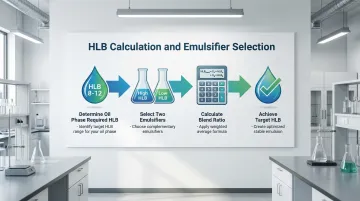
Formulators must calculate the required HLB for their specific oil blend by determining the weighted average HLB of all oils in the formulation, then selecting emulsifiers that match this target. For example, if your oil phase requires an HLB of 12, you might blend an emulsifier with HLB 8 and another with HLB 16 in appropriate ratios to achieve the target value.
Essential Oil Phase Ingredients
Carrier Oils and Their Selection
Not all carrier oils function identically on hair. Each has distinct penetration profiles that guide oil selection based on your target hair concerns.
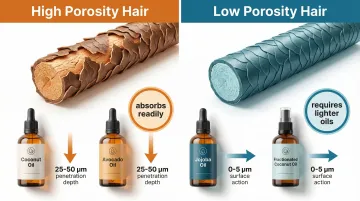
Coconut Oil:
- Penetrates deeply into the hair cortex (up to 50 µm in virgin hair)
- High affinity for hair proteins due to low molecular weight and linear lauric acid structure
- Reduces protein loss during washing
- Ideal applications: Deep repair, protein retention, damaged hair
Argan Oil:
- Limited penetration in virgin hair (0-5 µm), primarily surface action
- Provides shine, smoothness, and cuticle protection
- Higher diffusion in bleached or chemically treated hair
- Works well for: Surface conditioning, frizz control, shine enhancement
Jojoba Oil:
- Technically a liquid wax ester with composition similar to human sebum
- Excellent for all hair types due to sebum-mimicking properties
- Provides lightweight conditioning without heaviness
- Recommended for: Fine hair, scalp health, universal formulations
Avocado Oil:
- Moderate penetration (up to 25 µm)
- Rich in oleic acid and vitamins A, D, and E
- Reinforces the cell membrane complex
- Targets: Dry, brittle hair needing strength and elasticity
Meadowfoam Seed Oil:
- Over 98% long-chain fatty acids providing exceptional stability
- Creates protective barrier on hair shaft
- Extends shelf life of formulation due to oxidative stability
- Especially effective for: Color-treated hair, heat protection, long-lasting conditioning
When selecting oils, consider hair porosity. High-porosity hair (damaged, chemically treated) absorbs oils more readily and benefits from heavier oils like coconut and avocado.
Low-porosity hair requires lighter oils like jojoba or fractionated coconut oil to avoid buildup.
Emollient Ingredients
Fatty alcohols serve dual functions in cream shampoo formulations: they act as co-emulsifiers and provide the rich, creamy texture consumers expect.
Cetyl Alcohol, Stearyl Alcohol, and Cetearyl Alcohol:
- Despite the name "alcohol," these are fatty alcohols that condition rather than dry
- Form lamellar gel networks that trap water and stabilize emulsions
- Provide slip for detangling and improve wet combing
- Typical usage: 2-5% of total formulation
These differ fundamentally from drying alcohols like ethanol or isopropyl alcohol:
- Long carbon chains (C16-C18) make them solid at room temperature
- Highly conditioning rather than drying
- Increase viscosity and create structured water phases that resist separation
Essential Oils and Botanical Extracts
Essential oils enhance both performance and sensory experience, but require careful formulation to ensure safety and stability.
Tea Tree Oil:
- Antimicrobial properties benefit scalp health
- Helps control dandruff and sebum production
- Usage rate: 0.5-1%
Rosemary Oil:
- Traditionally used to promote scalp circulation
- Pleasant herbaceous scent
- Usage rate: 0.5-1.5%
Peppermint Oil:
- Provides cooling sensation on scalp
- Stimulating properties
- Usage rate: 0.25-0.75% (lower due to potency)
Safety considerations:
- Total essential oil content should not exceed 2% in rinse-off products
- Some essential oils are sensitizers. Conduct stability and compatibility testing before finalizing formulations
- Essential oils must comply with IFRA standards for their specific constituents
- For EU markets, the 26 fragrance allergens must be labeled if present above 0.01%
Botanical extracts like chamomile, green tea, and aloe vera provide additional benefits while supporting clean beauty positioning. Incorporate these at 0.5-3% depending on the extract's concentration and intended benefit.
Antioxidants and Oil Stabilizers
Preventing oil rancidity is critical for product stability and shelf life. Without proper protection, oils oxidize when exposed to heat, light, and air—producing off-odors and potentially irritating compounds.
Vitamin E (Tocopherol):
- Most common antioxidant in cosmetic formulations
- Usage rate: 0.1-0.5%
- Protects both the oil phase and the product from oxidative degradation
- Mixed tocopherols provide broader spectrum protection than alpha-tocopherol alone
Rosemary Extract:
- Natural alternative with potent antioxidant activity
- Contains carnosic acid and rosmarinic acid
- Usage rate: 0.05-0.2%
- Provides clean label appeal
Add antioxidants during the cooling phase (below 50°C) to prevent heat degradation. Pair with proper packaging—opaque bottles or UV-protective materials—to maximize shelf life.
Formulating for Toxin-Free Standards
Clean beauty formulations require careful ingredient sourcing to avoid petrochemical derivatives and synthetic compounds. Companies like Poison-Free Private Label have spent 30 years mastering this approach, offering over 100 formulations that meet strict toxin-free standards.
Plant-based alternatives to conventional ingredients:
- Use plant-derived squalane (from sugarcane or olives) instead of squalene from shark liver
- Select vegetable-derived glycerin rather than synthetic sources
- Choose plant oils over mineral oil or petrolatum
Mineral-based ingredients:
- Naturally occurring minerals like zinc oxide or titanium dioxide (when needed for specific functions)
- Mineral-rich clays for scalp treatments
Vitamin-derived ingredients:
- Tocopherols (Vitamin E)
- Panthenol (Provitamin B5)
- Biotin and other B vitamins
Avoid common petrochemical derivatives including mineral oil, petrolatum, synthetic fragrances, PEG compounds (unless plant-derived), and DEA/MEA/TEA compounds.
Verify ingredient sourcing through supplier documentation and certifications to ensure compliance with toxin-free standards.
Water Phase Components and Emulsification
Surfactant Selection for Cream Shampoos
Cream shampoos require gentler surfactant systems than clear shampoos due to their conditioning oil phase. The goal: balanced cleansing that removes buildup without stripping natural lipids or disrupting the emulsion.
Optimal surfactant concentration:
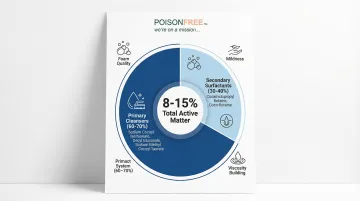
- Cream formulations: 8-15% total active surfactant matter
- Lower than clear shampoos (15-20%) because the oil phase helps remove dirt through oil-to-oil attraction
Primary cleansers (mild alternatives to sulfates):
- Sodium Cocoyl Isethionate: Gentle solid surfactant producing dense, creamy foam
- Decyl Glucoside: Sugar-based surfactant with excellent mildness profile
- Sodium Methyl Cocoyl Taurate: Amino acid-based with rapid, creamy foam
Secondary surfactants (foam boosters and viscosity builders):
- Cocamidopropyl Betaine: Amphoteric surfactant that reduces irritation and builds viscosity
- Coco-Betaine: Similar to above but with simpler structure and clean label appeal
- Sodium Lauryl Glucose Carboxylate: Mild glucoside derivative suitable for sensitive scalps
Combining primary and secondary surfactants creates systems where ingredients work together, allowing you to reduce total surfactant load while maintaining cleansing power and foam quality.
A typical ratio is 60-70% primary cleanser to 30-40% secondary surfactant.
Emulsifier Systems
Emulsifiers are the backbone of cream shampoo stability, binding oil and water phases into a cohesive structure.
Key emulsifiers for shampoo formulations:
- Polysorbate 20 (HLB 16.7): Nonionic emulsifier excellent for light oils; helps dissolve essential oils into water phase (1-3%)
- Polysorbate 80 (HLB 15.0): Handles heavier oils and larger oil loads; provides stability across temperature ranges (1-3%)
- Ceteareth-20 (HLB ~15.5): Ethoxylated fatty alcohol with excellent emulsifying properties; creates stable, rich creams (2-4%)
- Polyglycerol Esters: Natural alternative to ethoxylated emulsifiers; derived from glycerin and fatty acids (2-5%)
Calculating required emulsifier amounts:
- Determine the required HLB of your oil phase (typically 8-12 for most hair oils)
- Select two emulsifiers—one with HLB above and one below your target
- Use this formula to calculate the blend ratio:
% High HLB Emulsifier = [(Required HLB - Low HLB) / (High HLB - Low HLB)] × 100
For example, if you need HLB 12 and you're blending Polysorbate 80 (HLB 15.0) with Glyceryl Stearate (HLB 3.8): % Polysorbate 80 = [(12 - 3.8) / (15.0 - 3.8)] × 100 = 73%
This means you'd use 73% Polysorbate 80 and 27% Glyceryl Stearate in your emulsifier blend to achieve optimal stability.
Conditioning Agents and Cationic Polymers
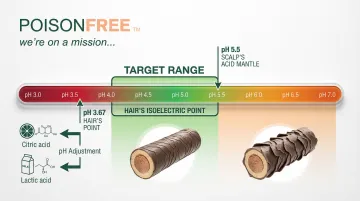
Hair has a negative surface charge (isoelectric point ~3.67), which increases with damage. Positively charged conditioning agents naturally attract to this negatively charged surface.
Cationic quaternary compounds:
- Cetrimonium Chloride: Provides detangling and smoothness; usage 0.25-1%
- Behentrimonium Chloride: Longer chain provides superior conditioning for damaged hair; usage 0.5-2%
- Guar Hydroxypropyltrimonium Chloride: Natural conditioning polymer from guar gum; usage 0.1-0.5%
Cationic polymers:
- Polyquaternium-7: Low molecular weight, provides volume and light conditioning
- Polyquaternium-10: Cellulose-based, excellent for building body without weight
- Polyquaternium-67: Film-forming polymer that provides heat protection
Molecular weight determines how well these polymers deposit. Higher molecular weight polymers deposit more effectively but may build up with repeated use. Balancing molecular weights creates formulations that condition without causing heaviness.
Damaged hair, with its lower isoelectric point and higher negative charge density, attracts more cationic conditioning agents. This self-adjusting mechanism means cream shampoos automatically deliver more conditioning to areas that need it most.
Protein and Humectant Additions
Hydrolyzed proteins strengthen hair structure:
- Hydrolyzed Wheat Protein: Small molecular size allows penetration into the hair's inner layer; improves elasticity (0.5-2%)
- Hydrolyzed Silk Protein: Provides smoothness and shine; forms protective film (0.5-2%)
- Hydrolyzed Keratin: Hair-mimicking protein that integrates into damaged areas of hair shaft (0.5-2%)
Humectants attract and retain moisture:
- Glycerin: Most common humectant; draws moisture from environment into hair (2-5%)
- Panthenol (Provitamin B5): Penetrates hair shaft, improves moisture retention and shine (0.5-2%)
- Sodium PCA: Natural moisturizing factor; excellent water-binding capacity (0.5-2%)
Add heat-stable proteins to the water phase before emulsification. Add heat-sensitive proteins and some humectants during the cooling phase.
When formulating toxin-free products, selecting plant-derived proteins and naturally sourced humectants ensures clean-label appeal without compromising performance.
Thickening and Viscosity Control
Achieving the right cream consistency requires strategic use of thickeners.
Primary thickeners:
- Xanthan Gum: Creates shear-thinning texture; usage 0.2-0.8%
- Guar Gum: Provides smooth, creamy viscosity; usage 0.1-0.5%
- Sodium Chloride (Salt): Thickens anionic surfactant systems; usage 0.5-2%
Target viscosity for cream shampoos: 3,000-8,000 centipoise (cps)
Viscosity affects user perception of quality and conditioning efficacy. Too thin, and consumers perceive the product as watery or ineffective. Too thick, and it becomes difficult to dispense and distribute through hair.
Salt thickening works through a specific mechanism with anionic surfactants. Small amounts cause surfactant micelles (tiny spherical structures) to grow, increasing viscosity. However, too much salt causes the opposite effect—micelles shrink and viscosity drops.
The optimal salt concentration must be determined through testing, typically falling between 1-2%.
Functional Additives and Performance Enhancers
pH Adjustment and Buffering Systems
Maintaining proper pH is critical for both hair health and formulation stability.
Optimal pH range: 4.0-5.5
Why this range matters:
- Hair's isoelectric point is ~3.67; pH above 5.5 causes cuticle swelling and lifting
- Scalp's acid mantle has a pH of ~5.5; matching this protects the scalp barrier
- Research on 123 shampoos found only 38% had pH ≤5.5, while 75% of professional salon products met this standard
- Preservative efficacy is pH-dependent; many preservatives work best below pH 6.0
Common pH adjusters:
- Citric Acid — lowers pH with typical usage of 0.1-0.5% as needed
- Lactic Acid — lowers pH while adding moisturizing properties
- Sodium Hydroxide (Caustic Soda) — raises pH; use cautiously in small increments
Buffering systems maintain pH stability over the product's shelf life. Citric acid/sodium citrate buffers are common in hair care, maintaining pH in the 4.5-5.5 range even as the product ages or is exposed to temperature fluctuations.
Preservation Systems
Oil-in-water emulsions face significant microbial contamination risk because bacteria thrive in the aqueous phase. Proper pH levels support preservative function, making preservation strategy the next critical formulation consideration.
Key preservation challenges:
- Lipophilic preservatives may concentrate in the oil phase, leaving the water phase unprotected
- Emulsions provide nutrients (oils, proteins, botanical extracts) that support microbial growth
- Consumer use introduces contamination through repeated opening and contact
Broad-spectrum preservative systems:
Synthetic options:
- Phenoxyethanol + Ethylhexylglycerin — effective combination providing broad-spectrum coverage at 0.8-1%
- Benzyl Alcohol + Dehydroacetic Acid — alternative system offering good efficacy (0.8-1% typical usage)
Natural alternatives:
- Leuconostoc/Radish Root Ferment — fermentation-derived preservative used at 2-4%
- Hurdle Technology — combines multiple strategies (low pH, antimicrobial oils, water activity reduction) to preserve without traditional preservatives
Efficacy testing requirements:
Challenge testing validates that preservative systems prevent microbial growth when intentionally contaminated:
- ISO 11930 — requires 3-log (99.9%) reduction in bacteria and 1-log (90%) reduction in yeast/mold by Day 7
- USP <51> — requires 2-log reduction in bacteria and no increase in yeast/mold by Day 14
Natural preservation systems typically provide shorter shelf life (12 months) compared to synthetic systems (24-36 months). Formulators must balance clean beauty positioning with practical shelf life requirements.
Formulation Process and Stability Considerations
Step-by-Step Manufacturing Process
Following the proper manufacturing sequence ensures stable emulsions and preserves ingredient efficacy throughout your product's shelf life.
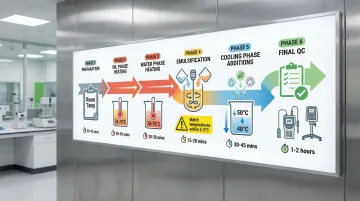
Phase 1: Preparation (Room Temperature)
- Weigh all ingredients separately
- Verify pH adjusters and preservatives are available for cooling phase
- Prepare clean, sanitized equipment
Phase 2: Oil Phase Heating
- Combine all oil-soluble ingredients (carrier oils, fatty alcohols, emulsifiers) in stainless steel vessel
- Heat to 70-75°C with gentle stirring
- Maintain temperature until all solid ingredients are fully melted
Phase 3: Water Phase Heating
- Combine water, surfactants, and water-soluble ingredients in separate vessel
- Heat to 70-75°C (matching oil phase temperature)
- Ensure all ingredients are fully dissolved
Phase 4: Emulsification
- Slowly add oil phase to water phase (or vice versa, depending on formulation) with high-shear mixing
- Maintain temperature at 70-75°C during combination
- Mix at high shear (5,000-15,000 s⁻¹) for 10-20 minutes until emulsion forms
- Reduce mixing speed and allow to cool to 50°C
Critical Note: Match temperatures between phases within 2-3°C. Significant temperature differences shock the emulsion, causing immediate separation or long-term instability.
Phase 5: Cooling Phase Additions
- At 50°C, add heat-sensitive ingredients (proteins, some botanical extracts)
- At 40°C, add preservatives, essential oils, and pH adjusters
- Check and adjust pH to target range (4.0-5.5)
- Continue cooling to 30°C with gentle mixing
Phase 6: Final Quality Control
- Check viscosity (target 3,000-8,000 cps)
- Verify pH is within specification
- Inspect appearance for uniform texture and color
- Allow to rest 24 hours, then recheck viscosity and pH
Stability Testing Requirements
Once manufacturing is complete, stability testing validates your formulation's performance over its intended shelf life under various storage conditions.
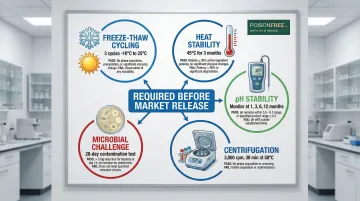
Essential stability tests:
Freeze-Thaw Cycling:
- Expose product to 3 cycles of -10°C to 25°C
- Each cycle: 24 hours frozen, 24 hours at room temperature
- Pass criteria: No phase separation, color change, or texture change
Heat Stability:
- Store at 45°C for 3 months (accelerated aging)
- This predicts approximately 2 years of shelf life at room temperature
- Check at 1, 2, and 3 months for separation, pH change, viscosity change, and microbial growth
pH Stability:
- Measure pH at initial formulation, then at 1, 3, 6, and 12 months
- pH should remain within ±0.5 units of target
- Significant pH drift indicates preservative degradation or ingredient incompatibility
Centrifugation Test:
- Heat sample to 50°C
- Centrifuge at 3,000 rpm for 30 minutes
- This rapid stress test reveals emulsions prone to creaming (oil rising to surface) or separation
- Pass criteria: No visible separation of phases
Microbial Challenge Testing:
- Intentionally contaminate preserved product with specified bacteria, yeast, and mold
- Test ability to kill or inhibit growth over 28 days
- Required for all emulsion products before market release
Shelf Life and Storage Considerations
Expected shelf life:
Properly formulated and preserved cream shampoos typically last 12-24 months. Products using natural preservation systems reach 12 months, while those with plant-based broad-spectrum preservation can extend to 24-36 months.
Key factors affecting shelf life:
- Antioxidants extend oil phase stability and prevent rancidity
- Opaque or UV-protective packaging prevents light-induced degradation of sensitive botanical ingredients
- Air-tight packaging minimizes oxidation of oils and active ingredients
- Storage temperature directly impacts aging rate—products stored above 77°F (25°C) age significantly faster
Storage recommendations:
- Store in cool, dry location away from direct sunlight
- Avoid temperature fluctuations
- Use opaque bottles or UV-protective materials for light-sensitive ingredients
- Consider airless pump packaging for premium formulations to minimize air exposure
Packaging considerations:
- HDPE or PET plastic bottles are standard for shampoos
- Glass is premium but adds weight and breakage risk
- Ensure compatibility between packaging materials and formulation (some essential oils can degrade certain plastics)
- Include appropriate closure systems that prevent contamination
Quality Standards and Bringing Your Formula to Market
FDA cGMP Compliance for Cosmetic Manufacturing
The FDA's current Good Manufacturing Practices (cGMP) for cosmetics, aligned with ISO 22716, set standards for safe, quality production.
Key compliance areas:
Facility cleanliness requirements include:
- Dedicated, clean manufacturing environment
- Regular sanitation protocols for equipment and surfaces
- Pest control programs
- Separate areas for raw materials, production, and finished goods
Ingredient verification must document:
- Documentation of ingredient identity, purity, and supplier certifications
- Certificate of Analysis (COA) for each raw material batch
- Verification that ingredients comply with FDA regulations for cosmetic use
Every production run requires comprehensive batch documentation:
- Master Batch Records detailing exact formulation and process steps
- Batch Production Records documenting actual production (temperatures, times, operator signatures)
- In-process quality checks (pH, viscosity, appearance)
- Retain batch records for at least 3 years
Quality control testing includes:
- Testing of finished products for pH, viscosity, appearance, and microbial contamination
- Stability testing to determine shelf life
- Preservative efficacy testing for emulsion products
- Documentation of all testing results
Compliance with these standards ensures product safety and positions your brand for retail partnerships that require third-party manufacturing audits.
Scaling from Lab to Production
Once your formula meets compliance standards, scaling to commercial production introduces new variables that can affect product quality.
Critical scale-up considerations:
Heat transfer differs significantly at scale:
- Large vessels heat and cool much slower than lab beakers
- This affects the crystallization of fatty alcohols and final viscosity
- Solution: Set specific heating/cooling rates and maintain them consistently
Mixing energy must be carefully translated:
- Lab-scale mixing with magnetic stirrers differs from industrial overhead mixers
- Shear rates must be calculated and replicated at scale
- Solution: Document exact mixing speeds and times; translate to production equipment specifications
Ingredient sourcing considerations:
- Lab-grade ingredients may differ from industrial-grade versions
- Suppliers may change between pilot and production
- Solution: Conduct compatibility testing with production-grade ingredients before scaling
Minimum order quantities present a significant barrier:
- Standard contract manufacturers typically require 3,000-5,000 unit MOQs
- This requires significant upfront investment for new brands
- Testing market viability with smaller runs reduces financial risk
For entrepreneurs developing toxin-free cream shampoo formulations, Poison-Free Private Label offers entrepreneur-friendly MOQs of 500 units. Their FDA cGMP compliant production facility in Northern Texas specializes in toxin-free, petrochemical-free formulations, making it possible to bring clean beauty cream shampoos to market without the large upfront investments typically required by conventional manufacturers.
This lower barrier to entry allows brands to test market response and refine formulations before committing to larger production runs.
Frequently Asked Questions
What is the formulation of oil-based cream shampoo?
Oil-based cream shampoos are oil-in-water emulsions containing 10-25% oil phase (carrier oils like coconut, argan, jojoba, plus emollients like cetearyl alcohol) and 8-15% mild surfactants. The formulation includes emulsifiers, cationic conditioning polymers, and functional additives (preservatives, pH adjusters, antioxidants) in a water base.
What are oil-based shampoos?
Oil-based shampoos are formulations with significant oil content (typically 10-25%) that cleanse while delivering deep conditioning. Unlike traditional shampoos that strip oils, these use emulsion technology to deposit beneficial oils during washing, making them ideal for dry, damaged, or chemically-treated hair.
What are the three types of shampoo formulations?
The three main types are: (1) Clear/transparent formulations—water-based with minimal oils and high surfactant concentration for deep cleansing; (2) Cream/opaque formulations—emulsion-based with 10-25% oil content providing conditioning benefits alongside cleansing; and (3) Solid/bar formulations—concentrated surfactants with minimal water, offering sustainable packaging and travel convenience. Each type serves different hair needs and consumer preferences.
How do you prevent oil-based cream shampoos from separating?
Prevent separation through proper emulsifier selection based on HLB calculations, maintaining correct manufacturing temperatures (70-75°C for both phases), and using appropriate mixing speeds to create stable droplets. Incorporate fatty alcohols that form lamellar gel networks and conduct rigorous stability testing (freeze-thaw cycles, heat aging) before release.
Can oil-based cream shampoos be made without synthetic preservatives?
Yes, but with limitations. Natural preservation systems like leuconostoc/radish root ferment, combined with hurdle technology (low pH, antimicrobial essential oils), can work. However, they provide shorter shelf life (12 months vs. 24-36 months) and require rigorous challenge testing for broad-spectrum coverage.
What hair types benefit most from oil-based cream shampoos?
Dry, damaged, color-treated, curly, and coarse hair types benefit most because these conditions involve compromised cuticles and reduced natural oils. The oil phase replenishes lipids, improves elasticity, and provides detangling slip. Fine or oily hair may find them too heavy, though lighter formulations (10-15% oil with jojoba) can work.