Introduction
The natural deodorant market has experienced significant growth in the U.S. over the past five years, as consumers increasingly seek aluminum-free, toxin-free personal care products. The global organic deodorant market reached $138.4 million in 2024 and is projected to hit $316.1 million by 2030, reflecting a 14.8% compound annual growth rate.
The clean beauty movement has fundamentally shifted consumer priorities, with 93% of U.S. consumers now using clean personal care products.
Entrepreneurs are increasingly launching deodorant brands because private label manufacturing has lowered traditional barriers to entry. You no longer need your own formulation lab or production facility.
With manufacturers offering minimum order quantities as low as 500-1,000 units, proven market demand for natural alternatives, and expanding e-commerce channels for personal care products, the opportunity to build a profitable deodorant brand is now within reach for startups and small businesses.
Ready to capitalize on this opportunity? This guide walks through what building a private label deodorant brand involves—from validating market demand to selecting a manufacturing partner to launching your first product.
Key Takeaways
- Launch your deodorant brand using proven formulations without production facilities
- Choose between stock formulas (fastest, lowest cost), semi-custom (modify scent/ingredients), or fully custom formulations (highest investment)
- Launch in 8-12 weeks with starting costs from $6,000-$17,500
- Success requires market validation, realistic pricing strategy, FDA cosmetic compliance, and clear brand differentiation
What Is a Private Label Deodorant Brand?
Private label deodorant is a business model where you partner with a manufacturer who produces deodorant using their existing formulations (or custom formulations), which you then sell under your own brand name and packaging.
You control branding, marketing, pricing, and customer relationships, while the manufacturer handles formulation expertise, production, and often fulfillment.
The private label spectrum offers flexibility based on your budget and timeline:
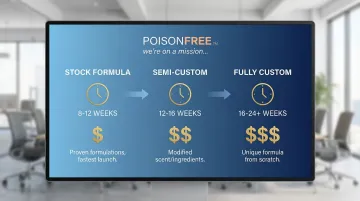
- Stock formula with your label: Fastest path to market (8-12 weeks), lowest cost, using proven formulations
- Semi-custom: Modify scent profiles or adjust specific ingredients while keeping the core formula intact (12-16 weeks)
- Fully custom formulation: Develop a unique formula from scratch specifically for your brand (16-24+ weeks, highest investment)
What to Know Before You Start a Deodorant Brand
Many aspiring brand owners underestimate the business-building work beyond "finding a manufacturer."
You'll need to handle brand development, regulatory compliance, marketing, sales channels, inventory management, and customer service—not just product sourcing.
Time investment reality:
- Planning phase (3-6 months): 10-20 hours per week for research, manufacturer vetting, and setup
- Post-launch operations: 20-40 hours per week managing operations, marketing, and growth
Financial runway you'll need:
- Initial inventory: $3,000-$15,000 for first production run
- Ongoing expenses: Marketing, website maintenance, packaging materials, and reorder capital
- Profitability timeline: 6-12 months before consistent profit
- Break-even target: 12-18 months (plan cash reserves accordingly)
Understanding these realities upfront helps you build sustainable momentum rather than running out of resources mid-launch.
Why Start a Deodorant Brand? (When It Makes Sense)
Strong Market Growth
The aluminum-free deodorant market was valued at $1.9 billion in 2023 and is projected to reach $3.8 billion by 2030, growing at a 10.2% CAGR.
Health concerns about aluminum and parabens in traditional antiperspirants drive this growth, with more than 65% of consumers actively seeking clean ingredient products.
Recurring Purchase Behavior
Deodorant is a consumable product with 30-90 day replenishment cycles. This creates opportunities for subscription models and strong customer lifetime value.
Subscription merchants saw 45% customer retention after 6 months and 33% retention after 12 months, significantly higher than one-time purchasers. Once you build a customer base, this recurring revenue model provides predictable cash flow.
Lower Barrier to Entry
Compared to other cosmetics, deodorant doesn't require complex formulation chemistry. The FDA classifies most deodorants as cosmetics (not drugs), which means no pre-market approval is required. Private label options allow you to launch without in-house R&D or production facilities, reducing startup capital requirements.
Differentiation Opportunities
While the market is competitive, there's room for brands targeting specific customer segments:
- Sensitive skin (baking soda-free formulations)
- Athletes (high-performance, long-lasting protection)
- Men's grooming (masculine scents, bold packaging)
- Plastic-free packaging (eco-conscious buyers)
- Specific scent profiles (unscented, floral, woodsy)
Successful niche brands prove this approach works. Schmidt's built their business around baking soda-free formulas for sensitive skin before being acquired by Unilever, while Wild scaled to millions in revenue with refillable deodorant cases targeting sustainability-focused consumers.
Early Decisions That Matter When Starting a Deodorant Brand
Most early-stage failures stem from underestimating true costs or overestimating initial sales velocity. Beyond the manufacturer's unit price, you'll pay for packaging, labeling, shipping materials, marketing spend, and working capital for reorders.
A $4 landed cost per unit can quickly become $6-7 when you factor in all these elements.
Four key decisions will shape your brand's trajectory and profitability:
Formula selection: Choosing between aluminum-free baking soda formulas (effective but can cause sensitivity for 20-30% of users) versus baking soda-free formulas (gentler but may require customer education on efficacy). Approximately 16% of men and 14% of women report skin irritation from deodorants, making baking soda-free formulations a significant market opportunity.
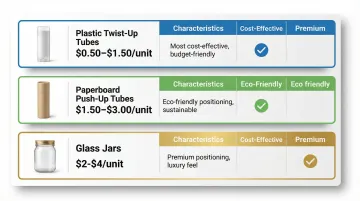
Packaging decisions: Your choice affects both cost and brand perception. Consider these options:
- Plastic twist-up tubes: $0.50-$1.50 per unit (most common, budget-friendly)
- Paperboard push-up tubes: $1.50-$3.00 per unit (eco-friendly positioning)
- Glass jars: $2-$4 per unit (premium positioning)
Choose packaging that aligns with your target customer's values and your pricing strategy.
SKU strategy: Should you start with one hero product or multiple scents? Most successful brands launch with 1-2 SKUs to focus marketing and minimize inventory complexity, then expand based on customer feedback.
Regulatory compliance reality check: While deodorant is classified as a cosmetic by the FDA and doesn't require pre-market approval, you're still responsible for proper labeling, ingredient disclosure, and safety.
Failure to comply can result in FDA warning letters or removal from marketplaces like Amazon.
How to Build Your Deodorant Brand – Step by Step
This section breaks the process into 8 practical stages, from initial validation through launch and stabilization.
Step 1 – Validate Market Demand and Identify Your Positioning
Research your specific customer segment: Identify whether you're targeting mainstream consumers switching from conventional deodorant, existing natural deodorant users seeking better options, or a specific niche like athletes, sensitive skin sufferers, or eco-conscious buyers.
Validate demand through primary research:
- Conduct surveys or interviews with 20-30 target customers
- Understand their current deodorant frustrations and purchase drivers
- Identify price sensitivity and interest in your positioning
- Look for patterns in ingredients they avoid, scents they prefer, and deal-breakers
Analyze competitive positioning:
- Study 5-10 existing deodorant brands in your target segment
- Understand their pricing ($8-$25 per unit is the common range)
- Evaluate their messaging, ingredient claims, and customer reviews
- Identify gaps in the market where your brand could differentiate
Step 2 – Choose Your Manufacturing Path and Vet Partners
Decide between three manufacturing approaches:
- Stock formula private label: Minimal customization, 4-8 week lead time, lowest cost
- Semi-custom: Scent/ingredient modifications, 8-12 week lead time, moderate cost
- Fully custom formulation: 12-20+ week lead time, highest cost and complexity
Research and compare manufacturers on critical factors:
- Minimum order quantities (industry standard is 5,000-10,000 units, though some offer 500-1,000 unit minimums)
- Lead times and production schedules
- Customization capabilities
- FDA cGMP compliance and facility certifications
- Unit pricing at different volume tiers
Vet manufacturers thoroughly:
- Request samples of their stock formulas for testing
- Check for FDA compliance and facility certifications
- Ask for customer references from similar-sized brands
- Clarify what's included in pricing (filling, labeling, packaging assembly)
- Understand their reorder process and lead times
- Confirm payment terms (many require 50% deposit)
Manufacturers offering 500-unit minimums significantly reduce initial capital requirements compared to the industry-standard 10,000-unit minimums. This makes market testing more accessible for startups.
Step 3 – Develop Your Pricing Strategy and Financial Model
Calculate your true landed cost per unit:
- Manufacturer cost + packaging materials + labeling + shipping to you + any assembly labor
- This typically ranges from $2-$6 per unit depending on customization level and order size
Build a pricing model that supports sustainability:
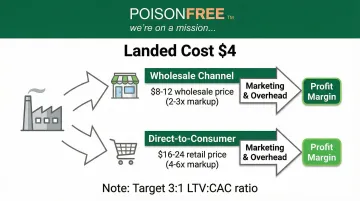
If your landed cost is $4 per unit:
- Wholesale pricing (if selling to retailers): $8-$12 (2-3x markup)
- Direct-to-consumer pricing: $16-$24 (4-6x markup) to cover marketing, overhead, and profit margins
Stress-test your model:
- Calculate break-even volume based on fixed costs
- Factor in realistic customer acquisition costs ($15-$40 per customer for DTC personal care brands)
- Ensure your pricing supports both profitability and competitive positioning in your segment
- Target a 3:1 LTV:CAC ratio for sustainable growth
Step 4 – Set Up Legal, Compliance, and Manufacturing Partnership
Business formation and legal setup:
- Register your business entity (LLC is common for product brands)
- Obtain an EIN for tax purposes
- Open a business bank account
- Secure product liability insurance ($1M-$2M coverage is standard for cosmetics)
FDA cosmetic compliance requirements:
Ensure your deodorant labeling meets FDA requirements:
- Ingredient declaration in descending order of predominance
- Net quantity statement
- Manufacturer/distributor information
- Any required warnings
Note that deodorants making antiperspirant claims (blocking sweat) require FDA drug approval—avoid efficacy claims unless pursuing OTC drug registration.
Finalize manufacturer agreement:
- Clarify MOQ requirements and lead times
- Understand payment terms (many require 50% deposit)
- Establish quality control processes
- Define what happens if product doesn't meet specifications
- Document reorder procedures
Manufacturers with 500-unit minimums significantly reduce initial capital requirements for startups.
Supplier setup for packaging and materials:
If providing your own containers or labels, establish relationships with packaging suppliers and label printers. Request samples to ensure compatibility with manufacturer's filling equipment.
Step 5 – Develop Your Product and Finalize Formulation
Choose your formulation approach: If using a stock formula, test samples yourself and with 10-15 people in your target demographic. Validate performance and gather feedback on texture, scent, and efficacy over 7-14 days of use.
Scent development: If customizing scent, work with your manufacturer to test fragrance or essential oil concentrations (typically 3-5% of formula). Order small test batches at different concentration levels before committing to full production.
Packaging and labeling decisions:
Finalize container type based on your brand positioning and budget:
- Plastic twist-up tubes: Most cost-effective at $0.50-$1.50 per unit
- Paperboard push-up tubes: Eco-friendly but cost $1.50-$3.00 per unit
- Glass jars: Premium positioning but cost $2-$4 per unit
Design labels that comply with FDA requirements while communicating your brand effectively.
Manufacturers with extensive toxin-free formulation libraries can significantly reduce formulation risk and time-to-market. Poison-Free Private Label offers over 100 plant-based, FDA cGMP-compliant formulations developed over 30 years.
Step 6 – Plan Inventory, Fulfillment, and Operations
Determine initial order quantity:
Balance manufacturer MOQ requirements with realistic sales projections and cash flow. Ordering 500-1,000 units is common for first production run, providing 3-6 months of inventory at projected early sales velocity.
Set up fulfillment operations:
- Self-fulfillment: Lower cost, more control, but time-intensive
- 3PL provider: Typically $3.18 per order plus storage fees in 2024
- For early-stage brands under 100 orders/month, self-fulfillment is usually more economical
Establish inventory management and reorder process:
- Track sell-through rate weekly
- Calculate reorder point based on manufacturer lead time (if lead time is 8 weeks, reorder when you have 10-12 weeks of inventory remaining)
- Maintain buffer stock to avoid stockouts during demand spikes
Step 7 – Build Your Brand and Go to Market
Develop brand identity and digital presence:
- Create a DTC e-commerce site (Shopify is most common platform for personal care brands)
- Develop brand messaging that clearly communicates your differentiation
- Set up basic email marketing infrastructure
Launch strategy:
- Consider starting with a small "friends and family" beta launch to gather testimonials and refine messaging
- Plan for a 90-day launch period focused on customer acquisition testing across 2-3 channels
Customer acquisition channels to test:
- Instagram and Facebook ads (typical for personal care DTC brands)
- Amazon (high competition but large existing search volume for "natural deodorant")
- Wholesale to local boutiques or gyms (lower margin but can provide early validation and cash flow)
Step 8 – Monitor Performance and Refine Operations
Track key metrics:
- Customer acquisition cost (CAC)
- Average order value (AOV)
- Repeat purchase rate
- Customer lifetime value (LTV)
- For sustainable growth, LTV should be 3x CAC or higher
Gather and act on customer feedback: Monitor reviews and direct customer feedback for insights on product performance, scent preferences, packaging usability, and any sensitivity issues. Use this data to refine your product or develop additional SKUs.
Stabilize before scaling: Resist the urge to launch new products or scale marketing spend until you've achieved consistent monthly revenue, proven your pricing model is profitable, and established reliable fulfillment operations. Most successful brands stabilize their first product for 6-12 months before expanding.
Conclusion
Building a successful private label deodorant brand requires executing the fundamentals well: thorough market validation, strategic manufacturer partnership, compliant and competitive product development, and disciplined go-to-market execution.
Speed to market matters less than getting core decisions right. Your long-term success hinges on three priorities:
- Choosing the right manufacturing partner with toxin-free formulations and entrepreneur-friendly minimums
- Pricing for profitability while building genuine differentiation in a competitive category
- Understanding your specific customer segment and delivering a product that genuinely solves their problems
The natural deodorant market offers significant opportunity. Manufacturers like Poison-Free Private Label make it easier to start with 500-unit minimums priced at volume rates, allowing you to test the market without overcommitting capital. Focus on building sustainable unit economics from day one rather than rushing to launch.
Frequently Asked Questions
How to start your own deodorant company?
Partner with a private label manufacturer, finalize your branding and packaging, ensure FDA cosmetic compliance, and launch through DTC or wholesale channels. The private label path allows you to launch in 3-6 months with $6,000-$17,500 in starting capital.
What are examples of private label brands?
Many well-known natural deodorant brands use private label manufacturing, partnering with contract manufacturers rather than operating their own facilities. Private label doesn't mean "generic"—you maintain full control over formulation selection, ingredients, scent, packaging, and branding.
What is the minimum investment to start a deodorant brand?
Total starting investment typically ranges from $6,000-$17,500, covering initial inventory ($3,000-$8,000 for 500-1,000 units), packaging and labeling ($500-$2,000), business setup and insurance ($500-$1,500), website and branding ($1,000-$3,000), and initial marketing ($1,000-$3,000).
How long does it take to launch a private label deodorant brand?
Stock formula private label launches in 8-12 weeks, semi-custom formulations take 12-16 weeks, and fully custom formulations require 16-24+ weeks. The timeline depends on whether you choose an existing formula or develop a custom formulation from scratch.
Do I need FDA approval to sell deodorant?
Deodorants are classified as cosmetics and do not require FDA pre-market approval, but you must ensure product safety and proper labeling. If you make antiperspirant claims (blocking sweat), the product becomes an OTC drug requiring FDA registration.
What's the difference between private label and custom formulation?
Private label uses a manufacturer's existing, proven formulation with your branding (customizable scent, but core formula stays the same), while custom formulation develops a unique formula from scratch for your brand. Private label is faster (8-12 weeks vs. 16-24+ weeks), lower risk, and more affordable, making it ideal for most new brands.