Introduction
Emerging CPG brands face a make-or-break decision: invest hundreds of thousands in manufacturing equipment and facilities, or partner with a contract manufacturer to bring products to market faster and cheaper. According to industry data, approximately 70% of personal care brands outsource production in their early stages to avoid capital expenditure—a strategic choice that can mean the difference between launching in 3 months versus 18 months.
This guide is for CPG brand owners, entrepreneurs, and startups evaluating whether to outsource production. You'll learn when contract manufacturing makes strategic sense, how costs break down, and what to look for in manufacturing partners.
We cover how contract manufacturing works, key success factors, and how to evaluate potential partners to control costs while scaling efficiently.
Key Takeaways
- Avoid $100,000+ facility costs by partnering with contract manufacturers who handle equipment, certifications, and compliance
- Match manufacturers to your product category, target volume, and quality requirements for optimal results
- Costs depend on formulation complexity, packaging choices, order volume, and materials
- MOQs range from 500 units (entrepreneur-friendly) to 10,000+ units (large-scale)
- Expect 2-4 weeks for stock formulations or 3-5 months for custom development
What Is CPG Contract Manufacturing?
Contract manufacturing (also known as co-manufacturing or private label manufacturing) lets brands outsource production to a third-party manufacturer. The manufacturer handles some or all aspects of bringing a product from concept to finished, retail-ready goods.
The outcome: Brands get finished products without owning manufacturing facilities, equipment, or managing production operations directly.
How it differs from related concepts:
- Unlike white-label: Contract manufacturing can involve custom formulations, not just pre-made products sold under your brand
- Unlike OEM: While similar in concept, OEM (Original Equipment Manufacturer) typically refers to electronics or automotive components; CPG contract manufacturing focuses specifically on consumer packaged goods like food, cosmetics, and household products
Understanding these distinctions helps you identify the right manufacturing partner for your specific product needs.
Why CPG Brands Use Contract Manufacturing
Capital Efficiency Advantage
Establishing an in-house facility requires $500,000 to $2 million+ in upfront capital for equipment, facility setup, and regulatory compliance infrastructure that can take 12-24 months to establish.
Small facility operational overhead alone runs approximately $82,000 per month in fixed costs.
In contrast, launching with a contract manufacturer can cost between $12,000 and $18,000 for an initial product batch—eliminating six-figure capital requirements that would otherwise lock up resources better spent on marketing and customer acquisition.
Speed-to-Market Demands
Established manufacturers already have the infrastructure ready:
- Proven formulations and supplier relationships
- Production capacity and equipment
- Regulatory certifications and compliance systems
These advantages reduce time from concept to retail-ready product from 18+ months to 3-6 months for custom formulations or as little as 2-3 weeks for stock formulations.
For trend-driven categories like beauty and personal care, getting to market faster can be the difference between capturing market opportunity and missing it entirely.
Flexibility and Risk Mitigation
Contract manufacturing allows brands to test market demand with smaller production runs before committing to large inventory investments. You can scale up or down based on sales performance without being locked into fixed overhead costs—a critical advantage when validating product-market fit.
Access to Specialized Expertise
Contract manufacturers bring specialized expertise across multiple areas:
- Formulation knowledge and product development
- Regulatory compliance (FDA registration, cGMP, organic certifications)
- Packaging engineering and quality control systems
- Navigation of complex regulations like MoCRA
For startups, accessing this expertise without building it in-house saves years of development time and significant capital investment.
Focus Advantage
Outsourcing production allows brand teams to concentrate resources on marketing, sales, distribution, and customer relationships rather than managing manufacturing operations and supply chain logistics. For startups with limited teams, maintaining this focus can mean the difference between scaling quickly and getting stuck in operational complexity.
How CPG Contract Manufacturing Works (Conceptual Flow)
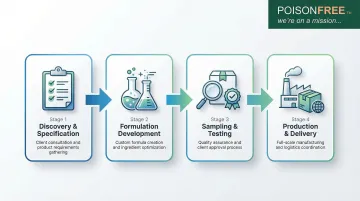
The process typically moves through these stages: initial inquiry and product specification → formulation development or selection → sampling and refinement → production setup → manufacturing run → quality control → packaging → fulfillment or delivery.
What goes into the process:
- Brand provides: Product concept, target specifications (ingredients, claims, format, packaging), budget parameters, and volume projections
- Manufacturer contributes: Formulation expertise, production capabilities, raw material sourcing, and regulatory guidance
The core transformation: Raw materials and components are processed, mixed, filled, packaged, labeled, and prepared for distribution according to your specifications and regulatory requirements.
Process control: Through agreed-upon specifications, quality control checkpoints, batch testing, production schedules, and ongoing communication between brand and manufacturer.
Here's how the workflow unfolds in practice:
Step 1: Discovery and Product Specification
You contact the manufacturer with your product concept: category (personal care, food, beverage, household), format preferences, target price point, and initial volume estimates.
The manufacturer assesses fit with their capabilities and provides preliminary feasibility feedback.
Key considerations at this stage:
- Does the manufacturer specialize in your product category?
- Can they meet your volume requirements and timeline?
- Do they have the necessary certifications for your target market?
Step 2: Formulation Development or Selection
You have two paths forward depending on your product differentiation goals:
Custom formulations: The formulation team develops a unique formula based on your requirements, desired claims (organic, vegan, toxin-free), performance specifications, and regulatory constraints. Custom formulation fees typically range from $1,000 to $12,000+ depending on complexity.
Stock formulations: You select from the manufacturer's existing product library and may request modifications to ingredients, fragrance, or potency. This option is faster and less expensive, ideal for brands prioritizing speed-to-market over unique formulations.
Step 3: Sampling, Testing, and Refinement
Small-batch samples are produced for your evaluation. You test for performance, sensory attributes, stability, and market appeal.
Ongoing refinement occurs until the formula meets all requirements. The final formula is locked and documented.
Testing requirements may include:
- Stability testing: $500 – $2,000 (typically requires 3 months according to accelerated testing protocols from certified laboratories)
- Preservative efficacy testing: $1,000 – $3,000
- Safety assessments: $800 – $1,500
Step 4: Production Setup and First Run
Raw materials are sourced, production is scheduled, equipment is set up, and pre-production quality checks are conducted.
The first production run (often at or near minimum order quantity) is completed with heightened quality oversight. You typically receive samples from the first run for approval before the full batch is released.
Where Contract Manufacturing Is Applied in CPG
Primary Product Categories
Contract manufacturing is most commonly used in:
- Personal care: Skincare, haircare, cosmetics (skin care accounts for 35% of market revenue)
- Food and beverage: Supplements, snacks, beverages, condiments
- Household products: Cleaners, detergents, air care
- Pet care products: Where formulation expertise and regulatory compliance are critical
Business Lifecycle Stages
Startups (<$1M revenue): Heavily rely on contract manufacturing to reduce risk and capital requirements. Nearly 100% of brands without technical founders use this approach.
Growth stage ($1M - $10M): Often transition to custom formulations to differentiate products while continuing to outsource production to maintain flexibility.
Maturity ($10M+): Large brands may bring high-volume "stable" products in-house to capture margin. However, they continue to outsource niche or complex items like aerosols or color cosmetics.
Typical Triggers
Brands typically seek contract manufacturing when:
- Launching a new product without capital for facilities
- Expanding beyond current production capacity
- Needing specialized capabilities (organic certification, specific packaging equipment)
- Testing innovations without disrupting core production
- The economics of in-house production don't justify the investment for projected volumes
Key Factors That Affect Contract Manufacturing Success in CPG
Minimum Order Quantities (MOQs) and Starting Investment
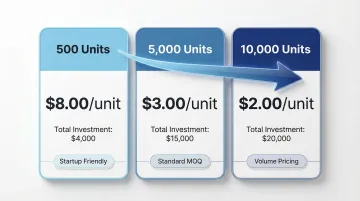
Industry-standard MOQs typically range from 5,000-10,000 units for established manufacturers, but entrepreneur-friendly manufacturers offer minimums as low as 500 units.
What this means for startup capital:
- 500 units at $8/unit = $4,000 initial investment
- 5,000 units at $3/unit = $15,000 initial investment
- 10,000 units at $2/unit = $20,000 initial investment
The trade-off: Lower MOQs come with higher per-unit costs. Unit costs might range from $1.50–$7.00 at 1,000 units but drop to $0.80–$3.00 at 20,000+ units due to economies of scale.
Formulation Complexity and Ingredient Sourcing
Custom formulations with specialty ingredients (organic, non-GMO, exotic botanicals) and clean-label requirements affect both cost and lead times. During recent supply chain disruptions, ingredient lead times fluctuated between 3 to 24 weeks.
Manufacturers with large raw material inventories can often reduce costs and speed up production. They cut out ingredient sourcing delays entirely.
Packaging Requirements and Customization
Packaging options create different cost structures:
- Stock packaging offers lower cost and faster turnaround, but limited differentiation
- Custom bottles, jars, and labels cost more with 30-45 day lead times, but build stronger brand identity
- Custom tooling for unique bottles or caps runs $5,000–$15,000
Packaging choices significantly impact both per-unit costs and minimum orders. A pump dispenser costs more than a screw-top, glass costs more than plastic, and custom printing requires higher minimums than stock labels.
Certifications and Compliance Requirements
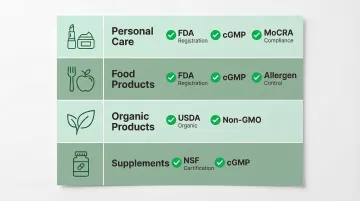
Beyond packaging, regulatory compliance shapes your manufacturer selection. Required certifications vary by product category:
- Cosmetics and personal care: FDA registration and cGMP compliance (legally required under MoCRA)
- Food products: FDA registration, cGMP, allergen control programs
- Organic claims: USDA Organic certification
- Supplements: NSF certification
- Household cleaners with antimicrobial claims: EPA registration under FIFRA
Manufacturers with existing certifications save you months and thousands in compliance expenses. You avoid the cost and hassle of obtaining certifications independently.
Geographic Location and Logistics
Manufacturer location directly impacts your operational costs and speed to market:
- Freight costs for raw materials and finished goods
- Lead times for delivery to distribution centers or retail customers (domestic: 3-6 weeks; offshore: 8-12 weeks)
- Responsiveness for urgent production needs or quality issues
Onshoring production often offsets higher unit prices. Reduced freight costs, shorter lead times, and lower inventory holding costs balance the equation against offshore options.
Common Issues and Misconceptions
The "Lowest Price Wins" Fallacy
Focusing solely on per-unit cost ignores the total cost of ownership. Hidden expenses add up fast:
- Quality issues requiring rework or returns
- Production delays that miss retail launch windows
- Minimum order requirements that tie up capital in excess inventory
- Time spent managing difficult vendor relationships
A manufacturer charging $0.50 more per unit but delivering on time with zero defects often costs less overall than a cheaper option that creates operational problems.
Maintaining Control With Contract Manufacturing
Brands maintain control over formulation specifications, quality standards, packaging design, and can require regular reporting and facility visits. The difference is operational control (how products are made) versus strategic control (what products are made and to what standards).
You're outsourcing execution, not decision-making authority over your brand's quality and positioning.
The "All Contract Manufacturers Are the Same" Assumption
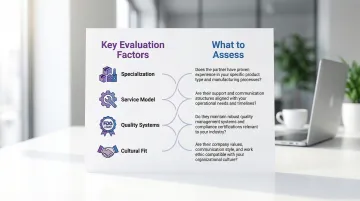
Manufacturers vary significantly across key factors:
- Specialization: Product categories, production scale, formulation capabilities
- Service models: Full-service vs. manufacturing-only
- Quality systems: FDA-registered cGMP facilities vs. basic operations
- Cultural fit: Partnership mentality vs. order-focused relationships
Choosing the right partner means evaluating these factors against your specific needs, not just comparing price quotes.
When Contract Manufacturing May Not Be Appropriate
While contract manufacturing offers compelling advantages for many CPG brands, certain situations call for in-house production instead. Understanding these scenarios helps you make the right strategic choice for your business.
Scenarios Where In-House Production Makes Sense
In-house production becomes more viable when:
- Production volumes consistently exceed 100,000+ units monthly and justify capital investment
- Proprietary formulations provide significant competitive advantage requiring strict protection
- Vertical integration drives your brand positioning—such as emphasizing facility ownership in marketing
- Your revenue exceeds $3-5 million and volumes reach 150,000-200,000 units per year for stable products
Capability Constraints
Consider building internal capacity when:
- Products require highly specialized equipment or processes that few manufacturers possess
- Formulation complexity demands extensive R&D collaboration difficult to manage externally
- Your product category falls outside typical contract manufacturing specializations
Timing and Control Limitations
Contract manufacturing may not work when:
- You need instant production flexibility (same-day or next-day runs)
- You require constant formula modifications that would disrupt the manufacturer's operations
- Quality control requirements demand on-site oversight challenging to maintain remotely
For brands with lower volumes (under 100,000 units monthly) or those testing new formulations, contract manufacturing often provides better economics and flexibility than building internal infrastructure.
Conclusion
CPG contract manufacturing enables brands to bring products to market faster, with lower capital investment, and with access to specialized expertise and infrastructure that would take years to build independently.
The personal care contract manufacturing market alone is projected to reach $40 billion by 2031, reflecting the growing recognition of outsourcing as a strategic advantage.
Success starts with understanding your specific needs: product category, volume, budget, and timeline. Then evaluate potential partners against those requirements, focusing on capabilities, MOQs, certifications, and communication style.
The right manufacturer is a strategic partner who brings expertise, reliability, and flexibility to help your brand grow.
If you're an entrepreneur or small brand entering the personal care or household products space, prioritize manufacturers with low MOQs and relevant certifications. Some manufacturers, like Poison-Free Private Label, offer 500-unit minimums with FDA cGMP-compliant facilities—making it easier to test market fit before scaling.
Frequently Asked Questions
How to find contract manufacturers?
Use online directories like Thomasnet and Maker's Row, industry associations like the Contract Packaging Association, or attend trade shows like Expo West. Create a shortlist based on product category specialization, then evaluate capabilities, certifications, MOQs, and cultural fit.
Is contract manufacturing the same as OEM?
Not quite. OEM typically focuses on electronics, automotive, and industrial components for rebranding. CPG contract manufacturing specifically handles consumer packaged goods and often includes formulation development, regulatory compliance, and packaging services beyond standard OEM relationships.
How much does contract manufacturing cost?
Costs vary by product complexity and volume. Typical ranges: $2-$15 per unit for personal care, $1-$8 per unit for household products, and $0.50-$5 per unit for food/beverage. Request fully-loaded quotes including setup fees, tooling, packaging, and shipping.
What is the minimum order quantity for contract manufacturing?
MOQs range from 500 units (entrepreneur-friendly manufacturers) to 5,000-10,000 units (standard minimums) to 50,000+ units (large-scale operations). Ask about MOQs early as this often determines feasibility for startups and small brands.
How long does it take to start production with a contract manufacturer?
Stock formulations take 2-4 weeks from order to delivery. Custom formulations need 4-8 weeks for development and sampling, plus 2-4 weeks for production. Total timeline typically ranges from 6-12 weeks.
What certifications should a CPG contract manufacturer have?
FDA registration and cGMP compliance are legally required for food and cosmetics under MoCRA. Look for category-specific certifications like USDA Organic, Non-GMO Project Verified, Kosher, or NSF for supplements. Always verify certifications are current and request audit reports.