Introduction
Private label manufacturing has become highly accessible for entrepreneurs, with successful brands launching for as little as $2,500-$5,000 while others invest $50,000+ depending on their goals and product complexity.
Many aspiring brand owners believe private label requires massive upfront capital, but the reality is far more nuanced. Costs vary dramatically based on product category, customization level, order quantity, and quality standards.
This article provides a comprehensive breakdown of all cost components—from initial product development to ongoing operational expenses—helping you budget realistically and avoid common financial pitfalls when launching your private label brand.
Key Takeaways
- Startup costs range from $2,500-$7,500 for simple products with low MOQs to $25,000-$50,000+ for custom formulations with premium packaging
- Understanding MOQ, customization level, and packaging complexity helps you predict total investment and negotiate better terms
- Expect one-time costs for development, design, and testing, plus recurring expenses for reorders and storage
- Start with smaller orders to test market demand, then scale up to lower per-unit costs once validated
How Much Does Private Label Manufacturing Cost? (Pricing Overview)
Private label manufacturing costs vary widely based on your product category, customization needs, order volume, and quality standards. There's no one-size-fits-all price.
Common mistakes drive up costs unnecessarily:
- Focusing only on product cost while ignoring packaging, compliance, and shipping
- Overcommitting to large MOQs before validating product-market fit
- Choosing the cheapest manufacturer without evaluating quality and reliability
Below are three typical investment ranges to help you budget realistically.
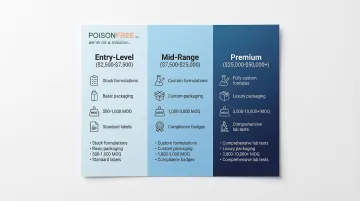
Entry-Level Investment ($2,500-$7,500)
What's Typically Included:
- Stock formulations with minimal customization
- Basic packaging options
- MOQ of 500-1,000 units
- Standard labeling
- Essential compliance documentation
Best For:
- First-time entrepreneurs testing market demand
- Businesses launching simple product lines (basic lotions, soaps, candles)
- Brands prioritizing speed-to-market over heavy customization
- Entrepreneurs seeking low MOQs (500 units) with competitive per-unit pricing
Mid-Range Investment ($7,500-$25,000)
What's Typically Included:
- Moderate formula customization
- Custom packaging design
- MOQ of 1,000-3,000 units
- Branded labels and secondary packaging
- Stability testing and compliance certifications
- Professional product photography
Best For:
- Established businesses expanding product lines
- Brands seeking moderate differentiation in competitive markets
- Entrepreneurs ready to commit to inventory after initial market validation
- Products requiring specific compliance standards (FDA-registered facilities, organic certifications)
Premium Investment ($25,000-$50,000+)
You Get:
- Fully custom formulations developed from scratch
- Premium packaging with complex printing and finishes
- MOQ of 3,000-10,000+ units
- Comprehensive safety and efficacy testing
- Trademark registration and brand protection
- Extensive marketing assets (photography, videos, samples)
Best For:
- Brands launching in ultra-competitive premium markets
- Products with novel ingredients or proprietary formulations
- Businesses with proven sales channels and established customer base
- Companies prioritizing maximum differentiation and brand positioning
Key Factors That Affect the Cost of Private Label Manufacturing
Understanding these factors helps you make strategic decisions about where to invest and where to save based on your specific business goals.
Product Category and Complexity
Different product types carry vastly different price points. Simple products like bar soaps or basic lotions typically cost less to manufacture than complex formulations like serums with active ingredients or products requiring specialized equipment.
Personal care and cosmetics often have higher compliance costs than household cleaners or candles due to FDA regulations and safety testing requirements.
Basic personal care products average $2.50-$4.50 per unit while specialty skincare with active ingredients averages $5.00-$8.00+ per unit at 1,000-unit MOQ, according to industry benchmarks. Formula complexity directly impacts both manufacturing costs and time to market.
Minimum Order Quantity (MOQ) and Economies of Scale
MOQ significantly impacts per-unit cost. A manufacturer might charge $8 per unit for 500 units but $4 per unit for 5,000 units of the same product due to setup costs, raw material bulk pricing, and production efficiency.
Some manufacturers, including Poison-Free Private Label, offer 500-unit MOQs with volume-style pricing to make private label more accessible to entrepreneurs. Most private label manufacturers set their baseline at 500 units per SKU for standard formulas.
Per-unit costs decrease significantly with volume increases.
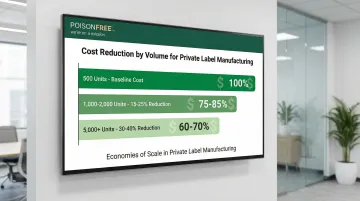
Cost reduction by volume:
- 500 units: Highest per-unit cost (baseline)
- 1,000-2,000 units: 15-25% reduction
- 5,000+ units: 30-40% reduction
Level of Customization and Formula Development
Customization levels create distinct cost tiers:
- Using existing stock formulas: $0-$500 (minimal to no development fees)
- Modifying stock formulas with custom fragrance/color: $500-$2,000
- Developing custom formulations from scratch: $3,500-$12,000+ in upfront R&D fees
Customization timeline also impacts costs—rush development adds 20-30% premium while standard timelines (8-12 weeks) offer better pricing. Manufacturers with extensive formula libraries can offer more customization options at lower costs than starting from zero. For example, Poison-Free Private Label maintains over 100 toxin-free formulations that serve as starting points for customization.
Packaging Design and Materials
Packaging accounts for 30-50% of total per-unit cost for premium products and serves as a critical brand differentiator.
Packaging cost components:
- Basic stock bottles/containers: $0.40-$1.50 per unit
- Custom molds for unique packaging: $8,000-$18,000 one-time tooling cost
- Labels and printing: simple labels $0.25-$1.00, complex multi-color $0.50-$1.50
- Secondary packaging like boxes: $0.30-$2.00 per unit
Choosing stock packaging for 1,000 units adds $1,000-$2,500 to total cost versus $8,000+ for fully custom packaging with specialized printing. For startups, stock packaging with high-quality labels minimizes upfront capital risk while still allowing strong brand presentation.
Compliance, Testing, and Certifications
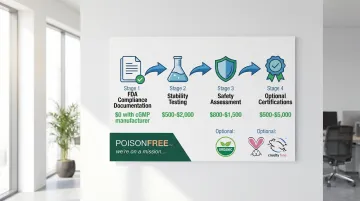
Mandatory costs:
- FDA compliance documentation (typically included by cGMP-certified manufacturers like Poison-Free Private Label)
- Stability testing: $500-$2,000 per product
- Preservative efficacy testing: $1,000-$3,000
- Safety assessments: $800-$1,500
Optional certifications that can justify premium pricing:
- Organic certification: $1,000-$5,000 annually
- Cruelty-free certification: $500-$2,000
- Specific claims substantiation: $1,000-$5,000 per claim
Working with FDA cGMP-certified manufacturers significantly reduces your compliance burden and risk, as many essential compliance elements are built into their standard processes.
Cost Breakdown of Private Label Manufacturing
Total cost extends far beyond the per-unit manufacturing price. Smart entrepreneurs account for all components when budgeting.
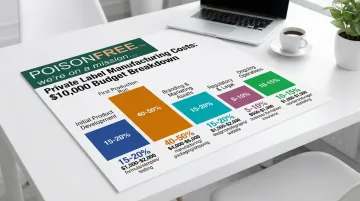
Here's a complete breakdown of one-time and recurring costs across five key categories:
Initial Product Development
One-Time Costs
Development costs include:
- Formula development or customization: $0-$10,000
- Sample rounds and revisions: $200-$800
- Stability and safety testing: $500-$3,000
- Packaging design and mockups: $300-$2,000 (external) or $0-$500 (in-house)
Some manufacturers include development costs in their MOQ pricing while others charge separately—clarify this upfront to avoid surprises.
First Production Run (Initial Inventory)
One-Time + Recurring for Reorders
Your first order typically includes:
- Product manufacturing at MOQ pricing: $1,500-$15,000
- Packaging and labeling materials (included in per-unit cost)
- Quality control inspection: often included or $200-$500 third-party
- Shipping to your warehouse: $200-$2,000
Example calculation: For 500 units at $5 per unit = $2,500 + $400 packaging + $300 shipping = $3,200 total first order
Fast turnaround times help reduce inventory holding costs. For example, manufacturers that ship within one week of receiving materials let you order smaller batches more frequently, lowering working capital requirements.
Branding and Marketing Assets
One-Time + Periodic Updates
Professional brand presentation requires:
- Logo and brand identity design: $300-$2,000
- Professional product photography: $500-$2,000
- Website development if selling D2C: $500-$5,000
- Initial marketing materials and samples: $300-$1,000
Professional branding significantly impacts conversion rates, with well-designed brands often seeing 20-40% higher conversion compared to amateur presentation.
Regulatory and Legal Costs
One-Time + Annual Recurring
Legal foundation costs include:
- Business formation and licensing: $200-$1,000 (one-time)
- Trademark registration: $250-$750 per class (one-time, optional)
- Product liability insurance: $500-$2,000 (annual)
- Compliance monitoring and label updates: $0-$500 (annual)
Ongoing Operational Costs
Recurring
Sustaining your business requires:
- Inventory reorders: costs decrease as volume grows
- Storage and fulfillment: $100-$1,000+ monthly
- Customer service and returns: $0-$500+ monthly
- Marketing and advertising: variable based on strategy
- Product reformulation or packaging updates: $500-$3,000 every 1-2 years
Low-Cost vs High-Cost Private Label Manufacturing — What's the Difference?
The price gap between low-cost and high-cost private label manufacturing isn't about quality—it's about strategy. When you work with reputable manufacturers, you're choosing between different approaches to customization, volume commitments, and market positioning. Each path offers distinct advantages depending on where you are in your business journey.
Speed to Market and Flexibility
Stock formulations with lower MOQs:
- Launch products in 4-8 weeks using existing formulas
- Test multiple products without large capital commitment
- Pivot quickly based on market feedback
Custom development with higher MOQs:
- Requires 12-20 weeks for formulation and production
- Locks you into larger inventory positions for extended periods
- Makes changes expensive once you produce custom molds and materials
For entrepreneurs testing new markets, manufacturers like Poison-Free Private Label offer 500-unit MOQs at the same pricing as 10,000-unit orders—eliminating the typical trade-off between flexibility and cost.
Your speed-to-market choice also shapes how you'll differentiate your brand.
Brand Differentiation and Market Positioning
Stock formula path:
- Limited product differentiation if competitors use similar formulas
- Competitive advantage comes from branding, marketing, and customer experience
- Harder to command premium pricing without unique product features
Custom formulation path:
- Unique formulations and packaging create immediate differentiation
- Premium pricing becomes easier to justify with proprietary products
- Builds stronger market protection, but demands proven demand before investment
The right choice depends on your market validation. If you're testing demand, stock formulations let you prove the concept before committing to custom development costs.
How to Estimate the Right Budget for Private Label Manufacturing
The "right" budget isn't about spending the most or least—it's about aligning investment with your business stage, risk tolerance, and growth strategy.
Start with Your Sales Channel and Volume Projections
Research your intended sales channel's requirements:
- Amazon FBA typically needs 500-1,000 units to start
- Retail stores may require 1,000-3,000 units for initial placement
- D2C websites can start with as few as 250-500 units
Calculate realistic first-year sales projections based on comparable products in your niche and your marketing budget. Work backwards from these projections to determine your appropriate MOQ.
Analyze 3-5 competitor products in your category and estimate their monthly sales volume using tools like Jungle Scout or Helium 10. Assume you'll capture 10-20% of the lowest performer's volume in your first 6 months.
Factor in All Cost Components and Build in Buffer
Create a comprehensive budget spreadsheet including:
- Product manufacturing (per unit × MOQ)
- Packaging and labeling
- Shipping and logistics
- Compliance and testing
- Branding and photography
- Initial marketing budget (typically 20-30% of first-year revenue goal)
- 20% contingency buffer for unexpected costs or delays
Balance Testing Needs with Economies of Scale
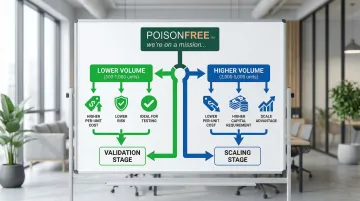
You'll need to balance two competing priorities:
Lower volume orders (500-1,000 units):
- Higher per-unit cost
- Reduced financial risk if product doesn't sell
- Ideal for testing market demand
Higher volume orders (2,000-5,000 units):
- Significantly lower per-unit cost
- Increased upfront capital requirements
- Higher risk if product underperforms
Start at lower MOQ for your first product launch to validate market demand. Once you have sales data proving demand, scale to larger orders for better unit economics.
Manufacturers offering low MOQs and fast turnaround times—such as Poison-Free Private Label with 500-unit minimums—give you this flexibility without sacrificing quality. Successful brands typically scale from 500-unit initial orders to 5,000+ unit orders within 12-24 months as they prove market demand.
What Most People Miss When Budgeting for Private Label Manufacturing
Underestimating the Full Cost of Inventory
Entrepreneurs often focus only on per-unit manufacturing cost while forgetting that inventory ties up cash in multiple ways:
- Shipping: $200-$2,000 per order
- Storage: $50-$500/month
- Working capital for reorders before selling through initial inventory
The 8-12 week reorder timeline means ordering your second batch when you're only 30-40% through your first—requiring significant cash reserves.
Ignoring the Cost of Poor Quality or Unreliable Partners
Choosing manufacturers based solely on lowest price without evaluating quality standards, compliance certifications (like FDA cGMP), and reliability can be devastating. Discovering quality issues after investing in 1,000+ units can cost $3,000-$10,000+ in lost inventory, damaged reputation, and delayed launch.
Approximately 75% of CPG innovations fail to maintain vitality beyond year one, often due to quality issues or insufficient market validation.
Failing to Budget for Marketing and Customer Acquisition
Even a perfect product won't succeed without customers knowing it exists. Assuming "if you build it, they will come" and putting your entire budget into product while leaving nothing for marketing is a critical mistake.
The average Customer Acquisition Cost (CAC) for beauty and personal care hovers around $61-$68, driven by paid social saturation. Successful brands typically allocate 25-40% of first-year budget to marketing and customer acquisition.
Research customer acquisition costs in your niche and ensure you have 3-6 months of marketing budget beyond product costs.
Conclusion
Private label manufacturing costs range from $2,500 to $50,000+ depending on product complexity, customization level, order volume, and quality standards. The investment is more accessible than many entrepreneurs assume, especially when working with manufacturers offering low MOQs and pricing structures designed for startups.
Understanding all cost components—from one-time development expenses to recurring operational costs—enables realistic budgeting and prevents common pitfalls that derail new brands.
The "right" investment isn't about spending the most or least. It's about strategically allocating resources to validate your product-market fit quickly, then scaling as you prove demand. Partner with manufacturers who support your growth stage and share your values from day one.
Frequently Asked Questions
How much does private label cost to start?
Starting costs range from $2,500-$7,500 for simple products with low MOQs, to $15,000-$50,000+ for custom formulations with premium packaging. Manufacturers offering 500-unit minimums make private label accessible even with limited budgets.
Is private label still profitable?
Private label remains highly profitable with typical margins of 40-80% compared to 20-50% for reselling branded products. Successful brands often achieve positive ROI within 6-12 months with effective cost management and smart positioning.
Is private labeling illegal?
Private labeling is completely legal and widely practiced across industries. You must follow proper labeling regulations and comply with industry-specific requirements (FDA for cosmetics, EPA for cleaners).
What is the minimum order quantity for private label products?
MOQs typically range from 500-10,000 units depending on manufacturer and product complexity. Poison-Free Private Label offers entrepreneur-friendly 500-unit minimums, making it easier to test products before scaling.
How long does it take to launch a private label product?
Typical timelines are 4-8 weeks for stock formulations, 8-12 weeks for moderate customization, and 12-20+ weeks for fully custom formulations. Manufacturers with large raw material inventories and fast turnaround can significantly accelerate launch.
What's the difference between private label and white label costs?
White label products are pre-made items with minimal customization ($1,500-$5,000 to start), while private label offers customizable formulations and packaging ($2,500-$25,000+). Private label provides better differentiation but requires higher investment.